Have you ever wondered how to tell if your pet lizard is preparing to shed its skin?
The truth of the matter is, all lizards shed their skin as they grow. This is because as the animal grows, its skin actually doesn’t grow with it, so when the animal outgrows the old skin, it becomes time for a new one. In scientific terms, this process is called ecdysis.
Some lizards will shed in a fast, singular fashion (i.e. shed their entire skin in a single session), but most shed their skin in pieces and the whole process may take several days to complete.
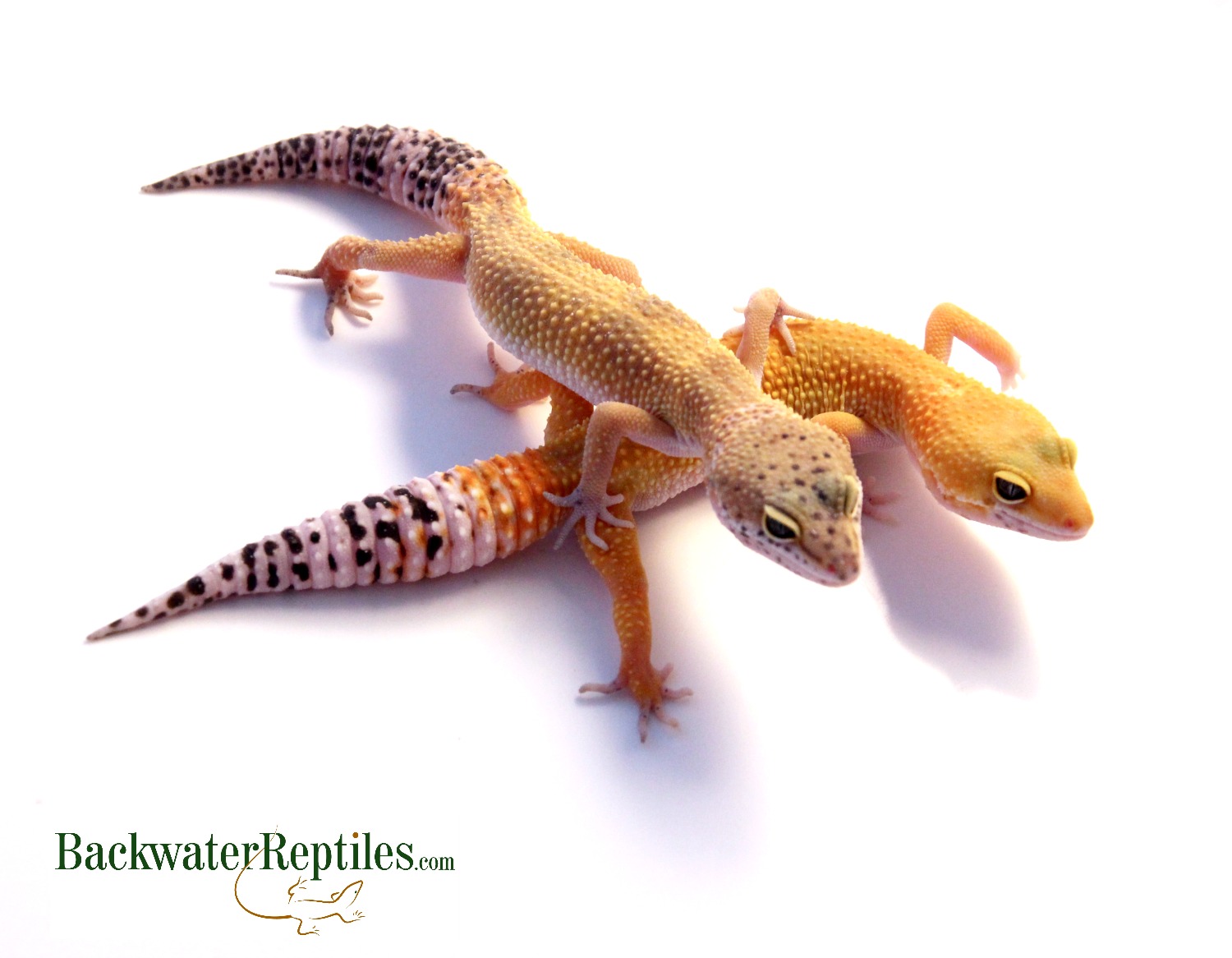
These are both tangerine morph leopard geckos. The gecko on the left is grey and dull because it is preparing to shed. The gecko on the right however is displaying its natural vibrant orange coloration. Can you see the difference?
Signs Your Lizard is Going to Shed
Nearly all lizards will become duller in coloration. Normally shiny and even iridescent scales will become matte and have a grey cast to them. This is a classic sign and because it affects your lizard’s physical appearance, most pet owners will notice right away.
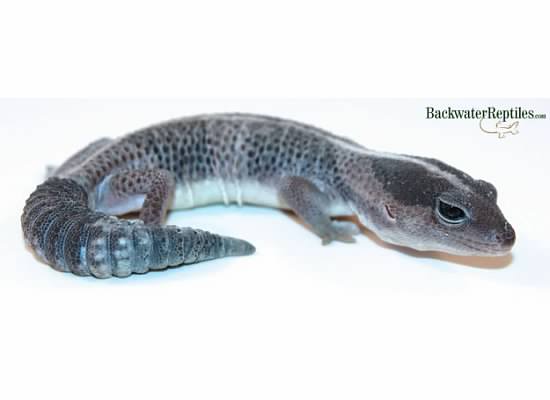
This African Fat Tail Gecko (Hemitheconyx caudicinctus) is preparing to shed. Normally this species of gecko is brown, but this guy is very dull and grey because he is in his pre-shed phase.
Your lizard’s behavior will also change. Many will refuse food for a day or two prior to shedding. Sometimes they will also become lethargic. They’ll probably be more secretive and will also dislike being handled or disturbed, so we recommend leaving them be until the process has finished.
What to Do When Your Pet Lizard Sheds
Due to temperament changes, we recommend minimal handling of your lizard during the shedding process.
Because the lizard will most likely refuse food, be sure to remove any crickets and other insects that aren’t being eaten. Crickets are known to nibble on vulnerable lizards, so if you don’t want your lizard to come to unnecessary harm, we recommend following this rule.
If your lizard is not grumpy, you can help it get rid of small pieces of skin that are loosely attached, but certainly don’t pull off pieces that are still hanging on to the animal as this could be painful.
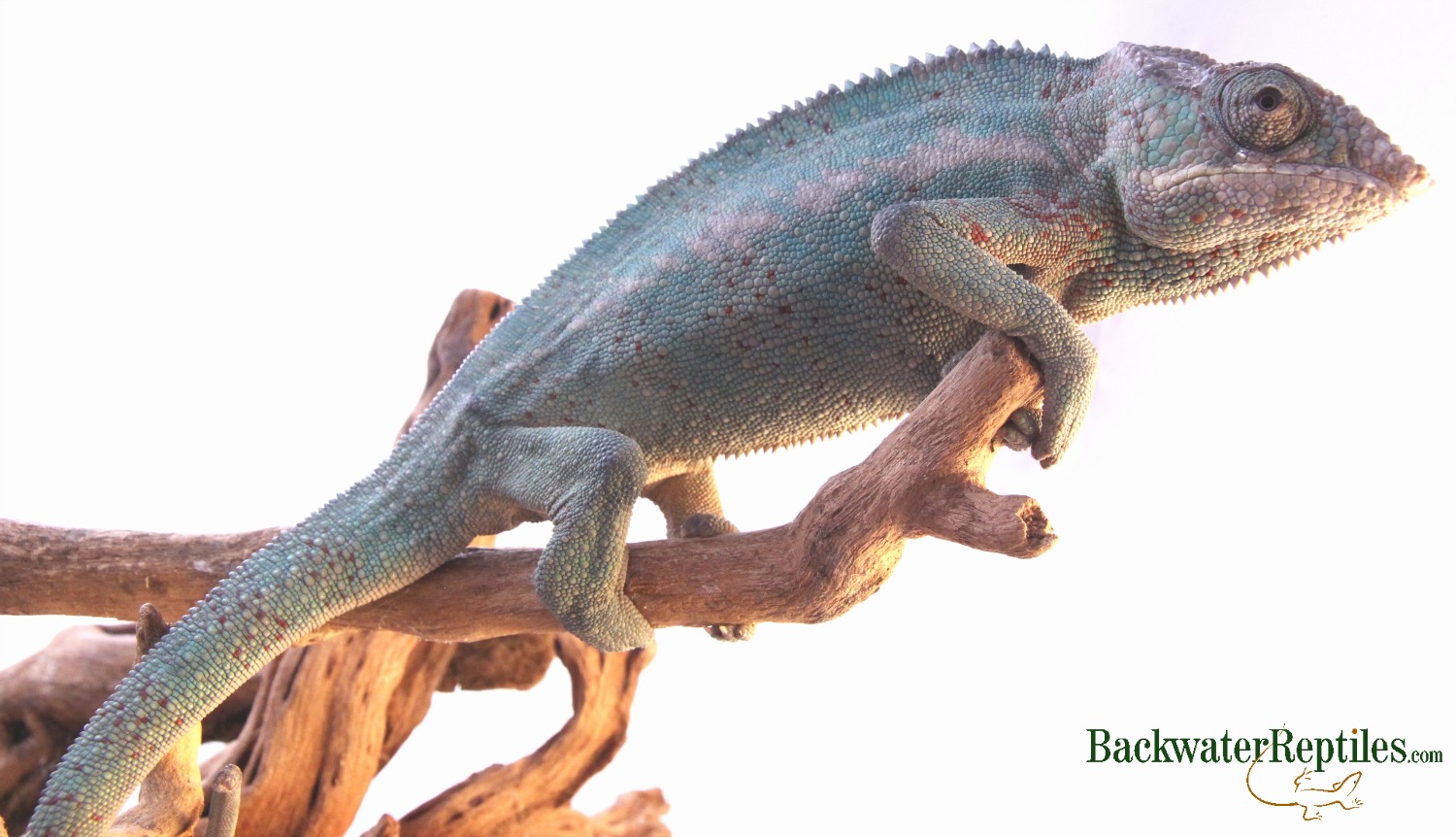
Although this male Panther Chameleon (Furcifer pardalis) might appear bright, in truth, they are generally much more of a brilliant blue tone. This particular chameleon will begin his shed process in a few days, so he is much duller than normal.
Problem Shedding
Sometimes your lizard might have trouble getting rid of its shed skin. An improper shed is called dysecdysis and can be dangerous to your lizard.
A number of things can actually cause dysecdysis ranging from improper humidity conditions to an ill animal.
If you feel that your lizard is suffering from an incomplete shed, we recommend veterinary attention, however there are home remedies you can try. Make sure that the lizard has plenty of accessories to rub itself against as it will use these items to help stubborn skin pieces fall off. Provide a bowl of water large enough for the animal to soak in, or alternatively, give the lizard mandatory soaking sessions in lukewarm water.
Fun fact: When leopard geckos shed they actually eat the skin they lose. They are master recyclers!
Conclusion
All lizards shed as a part of their natural growth process. When you notice signs that your lizard is going to shed (i.e. change in appetite and dull coloration) try to disturb the animal as little as possible. And keep an eye out for incomplete sheds, which could be a sign of a larger issue in the lizard’s habitat.
Backwater Reptiles, LLC, (Backwater Reptiles), is committed to keeping any and all personal information collected of those individuals that visit our website and make use of our online facilities and services accurate, confidential, secure and private. Our privacy policy has been designed and created to ensure those affiliated with Backwater Reptiles, LLC of our commitment and realization of our obligation not only to meet but to exceed most existing privacy standards.
THEREFORE, this Privacy Policy Agreement shall apply to Backwater Reptiles, LLC . Backwater Reptiles, LLC may also be in contact with you with regards to completing surveys and/or research questionnaires related to your opinion of current or potential future services that may be offered.
Backwater Reptiles, LLC does not now, nor will it in the future, sell, rent or lease any of our customer lists and/or names to any third parties.
Backwater Reptiles, LLC may deem it necessary to follow websites and/or pages that our users may frequent in an effort to gleam what types of services and/or products may be the most popular to customers or the general public.
Backwater Reptiles, LLC may disclose your personal information, without prior notice to you, only if required to do so in accordance with applicable laws and/or in a good faith belief that such action is deemed necessary or is required in an effort to:
Remain in conformance with any decrees, laws and/or statutes or in an effort to comply with any process which may be served upon Backwater Reptiles, LLC and/or our website;
Maintain, safeguard and/or preserve all the rights and/or property of Backwater Reptiles, LLC; and
Perform under demanding conditions in an effort to safeguard the personal safety of users of www.backwaterreptilesblog.com and/or the general public.
Children Under Age of 13
Backwater Reptiles, LLC does not knowingly collect personal identifiable information from children under the age of thirteen (13) without verifiable parental consent. If it is determined that such information has been inadvertently collected on anyone under the age of thirteen (13), we shall immediately take the necessary steps to ensure that such information is deleted from our system’s database. Anyone under the age of thirteen (13) must seek and obtain parent or guardian permission to use this website.
Unsubscribe or Opt-Out
All users and/or visitors to our website have the option to discontinue receiving communication from us and/or reserve the right to discontinue receiving communications by way of email or newsletters. To discontinue or unsubscribe to our website please send an email that you wish to unsubscribe to info@backwaterreptilesblog.com. If you wish to unsubscribe or opt-out from any third party websites, you must go to that specific website to unsubscribe and/or opt-out.
Links to Other Web Sites
Our website does contain links to affiliate and other websites. Backwater Reptiles, LLC does not claim nor accept responsibility for any privacy policies, practices and/or procedures of other such websites. Therefore, we encourage all users and visitors to be aware when they leave our website and to read the privacy statements of each and every website that collects personally identifiable information. The aforementioned Privacy Policy Agreement applies only and solely to the information collected by our website.
Security
Backwater Reptiles, LLC shall endeavor and shall take every precaution to maintain adequate physical, procedural and technical security with respect to our offices and information storage facilities so as to prevent any loss, misuse, unauthorized access, disclosure or modification of the user’s personal information under our control.
Changes to Privacy Policy Agreement
Backwater Reptiles, LLC reserves the right to update and/or change the terms of our privacy policy, and as such we will post those change to our website homepage at www.backwaterreptilesblog.com, so that our users and/or visitors are always aware of the type of information we collect, how it will be used, and under what circumstances, if any, we may disclose such information. If at any point in time Backwater Reptiles, LLC decides to make use of any personally identifiable information on file, in a manner vastly different from that which was stated when this information was initially collected, the user or users shall be promptly notified by email. Users at that time shall have the option as to whether or not to permit the use of their information in this separate manner.
Acceptance of Terms
Through the use of this website, you are hereby accepting the terms and conditions stipulated within the aforementioned Privacy Policy Agreement. If you are not in agreement with our terms and conditions, then you should refrain from further use of our sites. In addition, your continued use of our website following the posting of any updates or changes to our terms and conditions shall mean that you are in agreement and acceptance of such changes.
How to Contact Us
If you have any questions or concerns regarding the Privacy Policy Agreement related to our website, please feel free to contact us at the following email, telephone number or mailing address.
Reptile enthusiasts have been keeping anole lizards as pets for many years. They’re even readily available at chain pet stores these days. But did you know that there are actually many species of anoles? In this article, we’ll explain the similarities and details between the two most common types – the green anole (Anolis carolinensis) and the brown anole (Anolis sagrei).
Morphology & Appearance
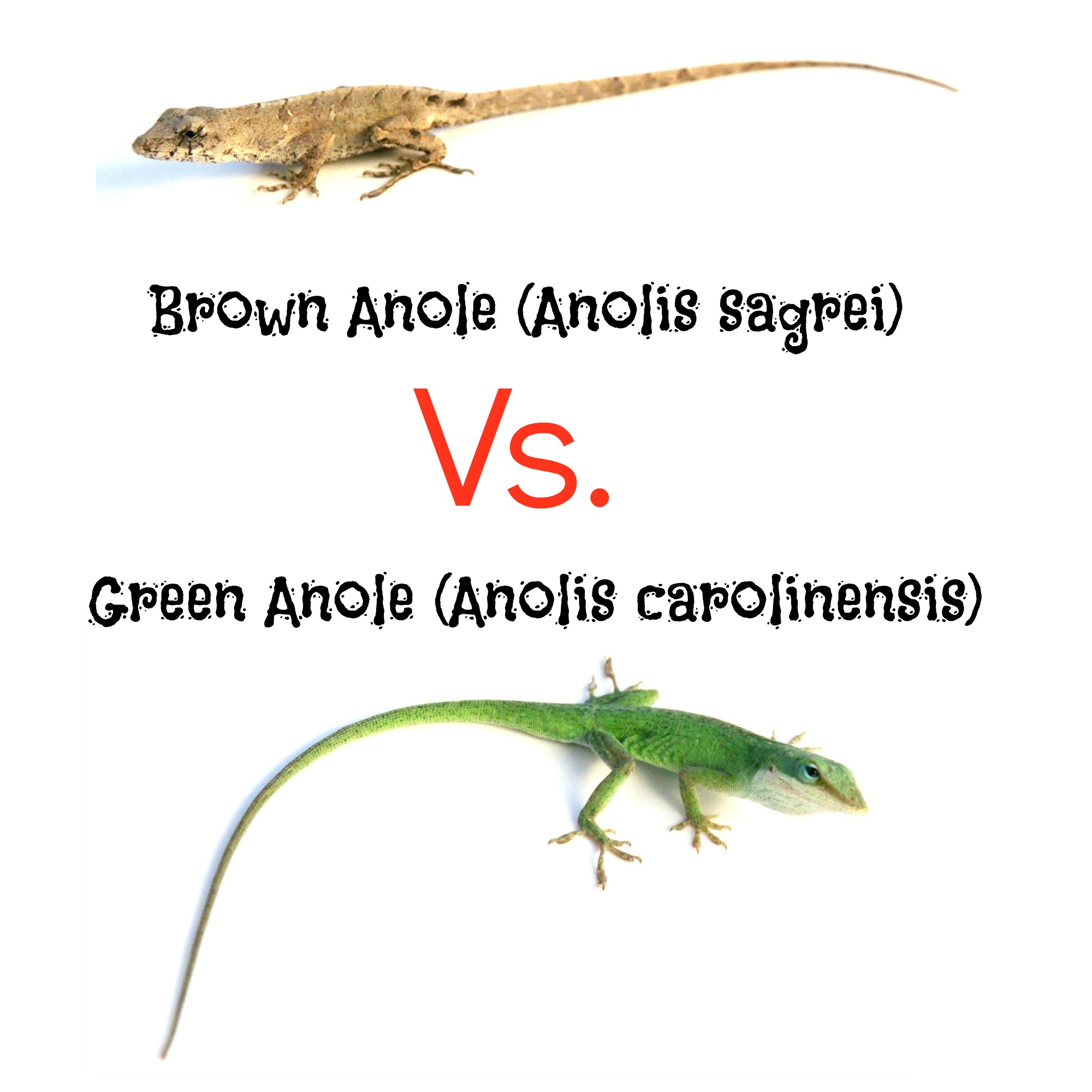
Would you believe that the main difference between brown and green anoles as far as looks go is color? The green anole is usually green and the brown anole is always some shade of brown…go figure, right?
As far as body shape goes, both species have long, lean bodies with limber legs and somewhat blocky, triangular heads. Each species also possesses a dewlap underneath its bottom jaw which is used in territorial displays. The green anole’s dewlap is pink or red while the brown anole’s is a dark reddish brown color.
See how the dewlap on this Brown Anole is a deep red in color?
Both species are able to change color within a limited spectrum. The green anole can display either a bright green color or a dull, brown shade. The brown anole, on the other hand, cannot turn green (i.e. is always brown) and will usually have stripes, spots, or bars on its back.
Habits & Lifestyle
Both anole species are insectivorous and will consume any insect they can fit in their mouths. They will even cannibalize smaller anoles!
Both the green and brown anole are fairly small lizards reaching virtually the same size when fully mature. Males are generally larger than the females and will max out at around eight inches in length. The females will grow to be around six inches long.
Both species can be found in the U.S., although only the green anole is native. The brown anole originated in Cuba and the Bahamas and is therefore considered an invasive species in the U.S. Currently, the two species occupy much of the same habitat and territory and compete fiercely.
Anoles, both green and brown, are avid climbers and are commonly found in trees, sunning on fences, and on the sides of houses.
Keeping Anoles in Captivity
As previously mentioned, green and brown anoles are very common pet lizards with virtually the same care requirements. They are very easy to maintain and make great starter lizards.
Because anoles are arboreal lizards, make sure that you have more vertical than horizontal enclosure space for either species of anole. These guys are climbers and feel at home in foliage, so be sure you include some vines and/or plant foliage that they can hide in.
Both green and brown anoles are “sunny” little lizards that enjoy warm climates, so your anole should get around eight hours of daylight (i.e. full spectrum UV lighting) as well as a heat lamp that maintains basking temperature of approximately 90 degrees in the daytime.
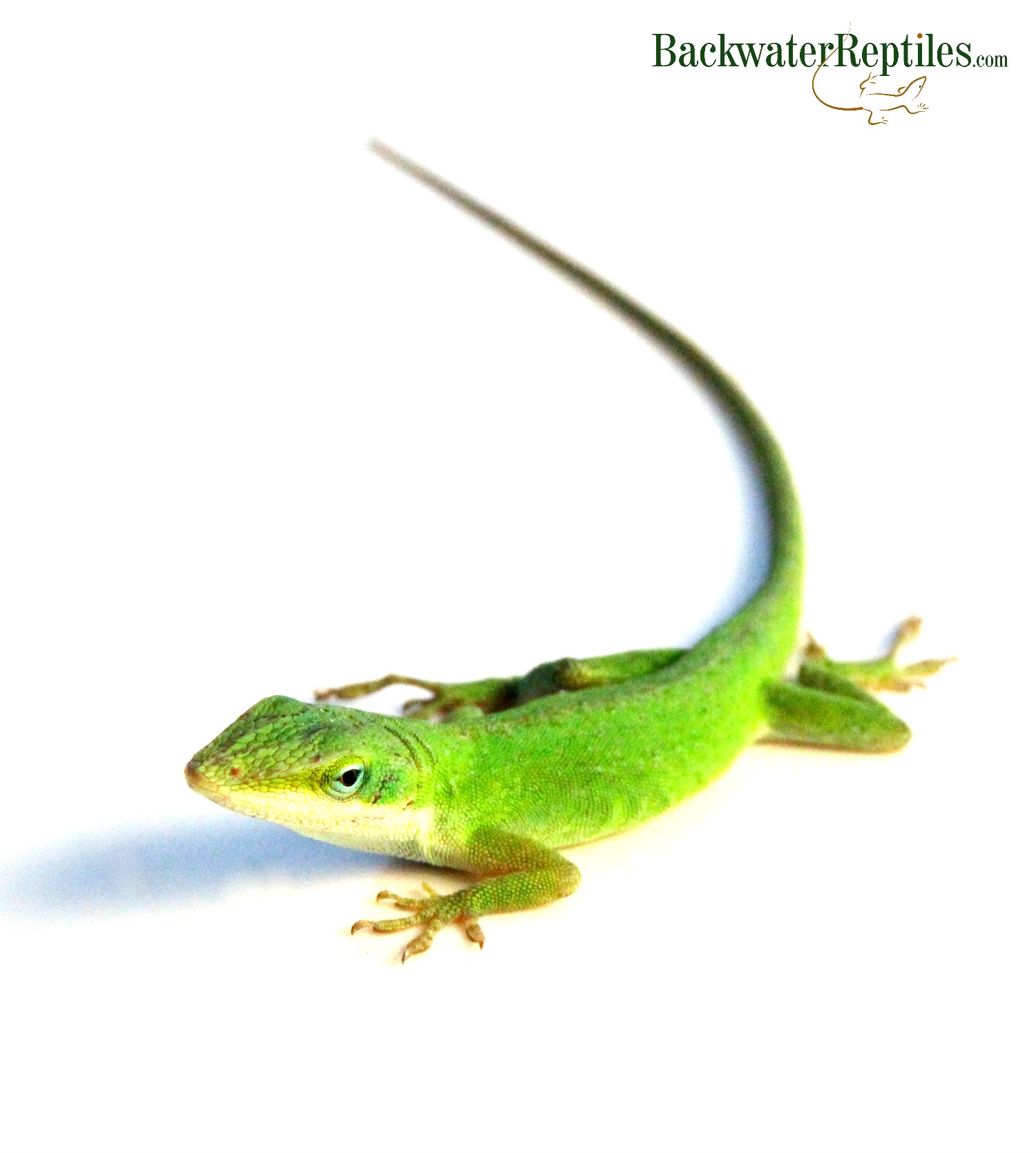
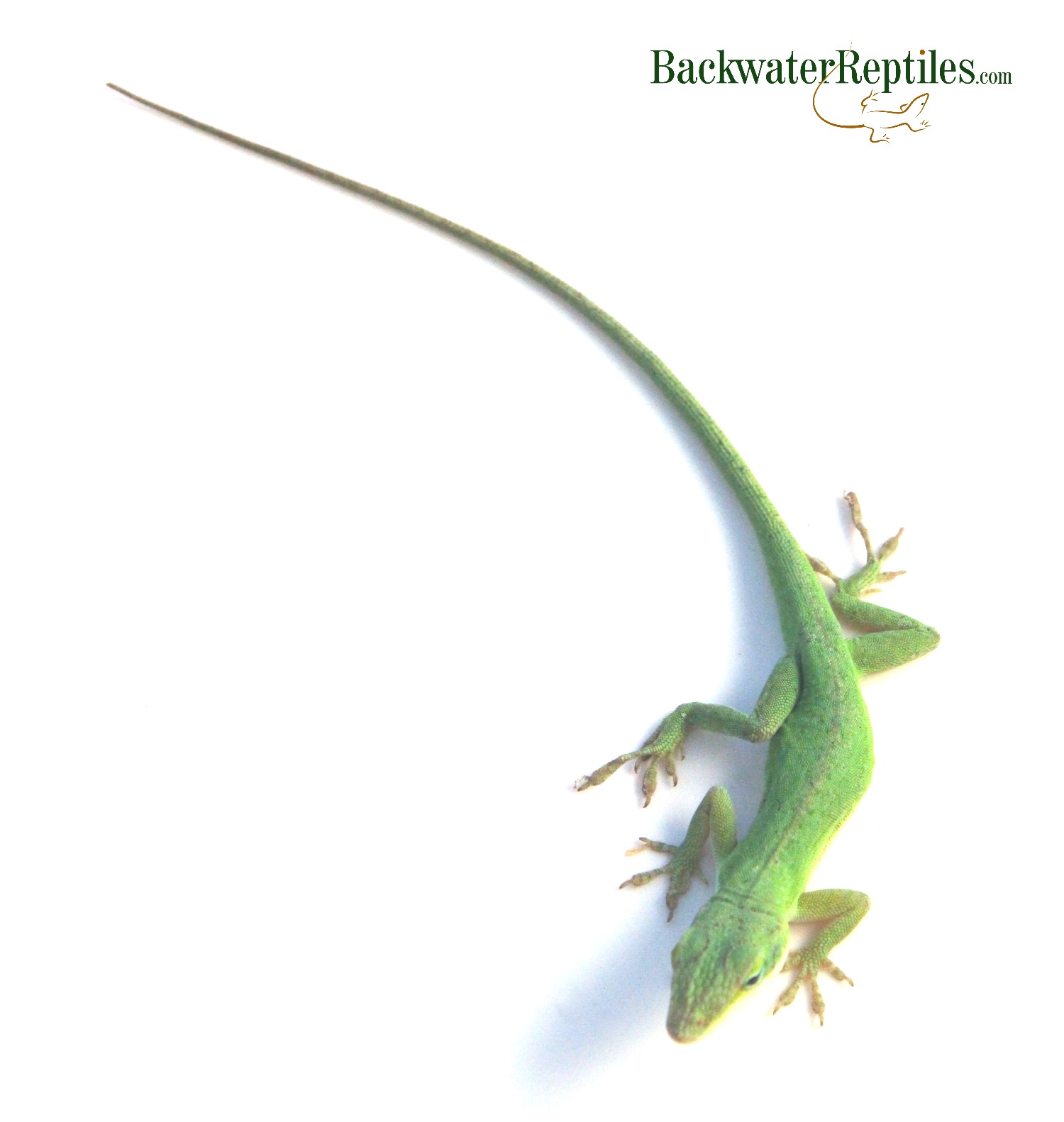
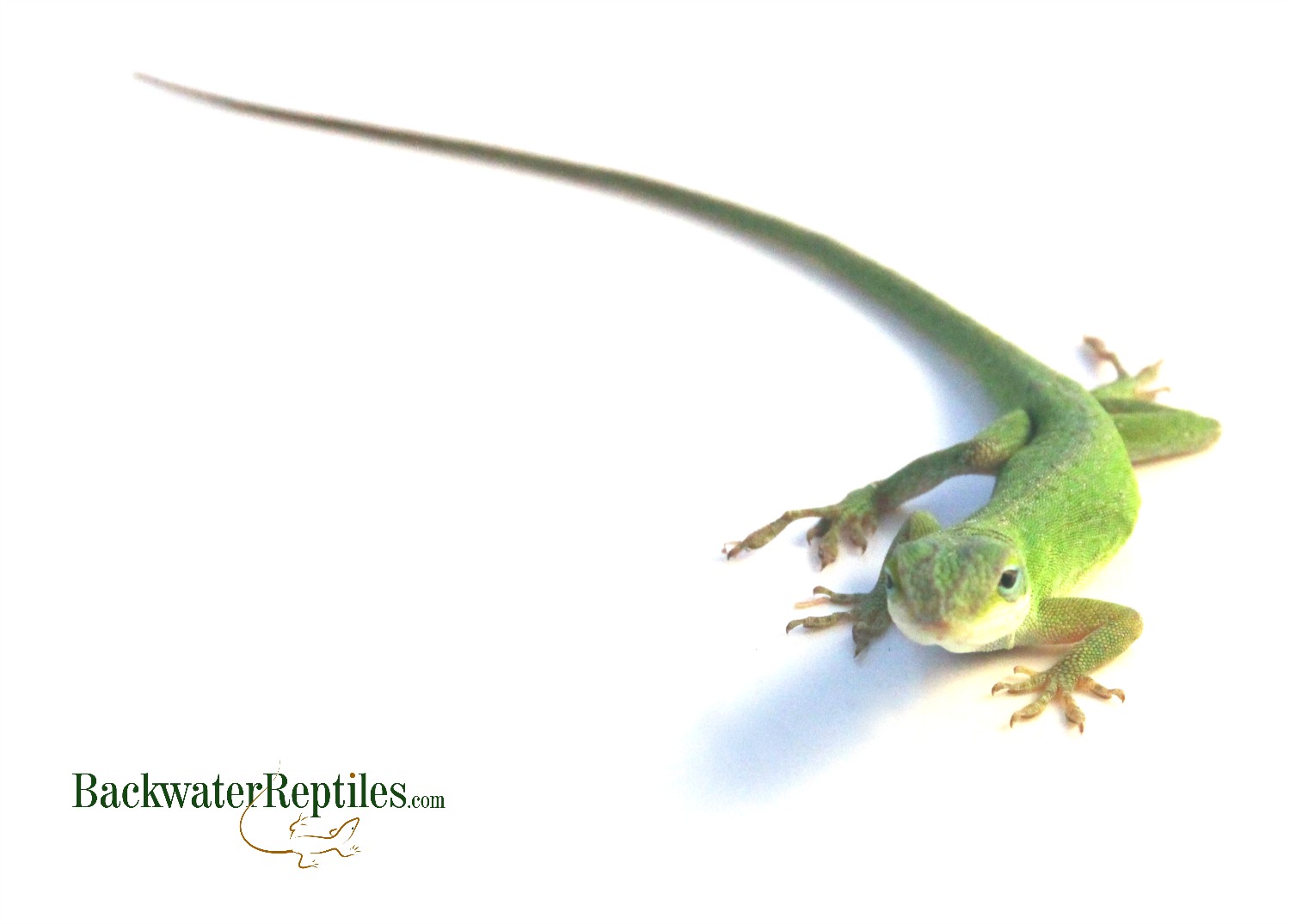
Here’s a top view of the Green Anole.
You can feed both species of anole crickets, meal worms, small roaches, and other appropriately-sized feeder invertebrates. A water dish can be provided, but don’t be surprised if your anole won’t drink from it, since not all anoles seem to recognize a water dish. Also, make sure the dish is very shallow because anoles can be trapped easily and drown in a deep water dish. If your anole doesn’t hydrate from a water dish, it will lap water that collects in little pools on leaves and branches, so misting would then be a requirement.
We hope this helps shed some light on the similarities and differences between these two common lizards. Backwater Reptiles offers both green anoles for sale as well as brown anoles for sale on our website.
Creating a Leopard gecko habitat is extremely simple, and we’ll explain exactly how to do it, based upon the tremendous success we’ve had with Leopard geckos at our facility. These lizards make wonderful pets as long as you support them correctly. We’ll provide some easy step-by-step instructions, so get ready to learn!
This beautiful hypo Tangerine male was raised in the same Leopard gecko habitat we’re describing in this article.
Leopard Gecko Habitat
Step 1: Let’s start with the cage itself. Leopard geckos don’t need much space to be happy, so larger is not necessarily better. You can use a standard ten-gallon glass tank to comfortably house a pair of geckos. A simple plastic bin can work just as well, albeit less visually appealing.
Note: don’t ever keep more than one male Leopard gecko per habitat, as they will brutally fight, often immediately upon introduction. We’re talking limb-over-limb-flying-through-the-air kind of fighting. However, several females can be kept in the same cage without issue.
Leopard Gecko Substrates
Step 2: Now that you’ve selected the cage for your Leopard gecko, it’s time to decide upon a substrate. Here are some viable options, with pros and cons:
Newspaper or paper towels – This is an inexpensive, absorbent option that is also easy to replace with fresh material when cleaning. It’s not visually attractive, however, doesn’t hold moisture, and doesn’t allow digging behavior.
Green carpet or turf – A slightly more aesthetically attractive option when compared to paper towels or newspaper, but very difficult to clean as waste accumulates in the fibers and must be washed regularly. It also doesn’t hold moisture or allow digging.
Sand or gravel (or a mixture) – These substrates can be attractive and a bit more natural, although there’s a mild risk of ingestion when eating. We’ve never had an issue with this occurring though, so I wouldn’t worry about it too much. These substrates can hold moisture fairly well, especially when mixed together.
Packed dirt, soil, or cypress mulch (or a mixture) – This substrate holds moisture very well, can form a biological system for breaking-down waste, and can sustain live plants. It can lead to a bit more dirt dust dispersed around the Leopard gecko habitat, but its merits far outweigh any negatives. The most natural choice, and our highest recommendation.
Any of the above substrate options can lead to a long, healthy lifespan for your pet Leopard gecko, so don’t fret too much over the choice. Although some disagree, we do think there’s an advantage to using a substrate that retains some moisture, and thus increases humidity within the cage.
Increased humidity helps shedding go smoothly, and helps prevent dehydration. Dehydration can lead to many issues, and can shorten a gecko’s lifespan. Just because they come from dry areas doesn’t mean the habitat should be dry.
Here are a couple of our Leopard geckos emerging from a tunnel they excavated. Digging is commonly enjoyed by these lizards.
Step 3: Now it’s time for the gecko habitat furnishings. There are three mandatory items, and one optional (but recommended) item, as follows…
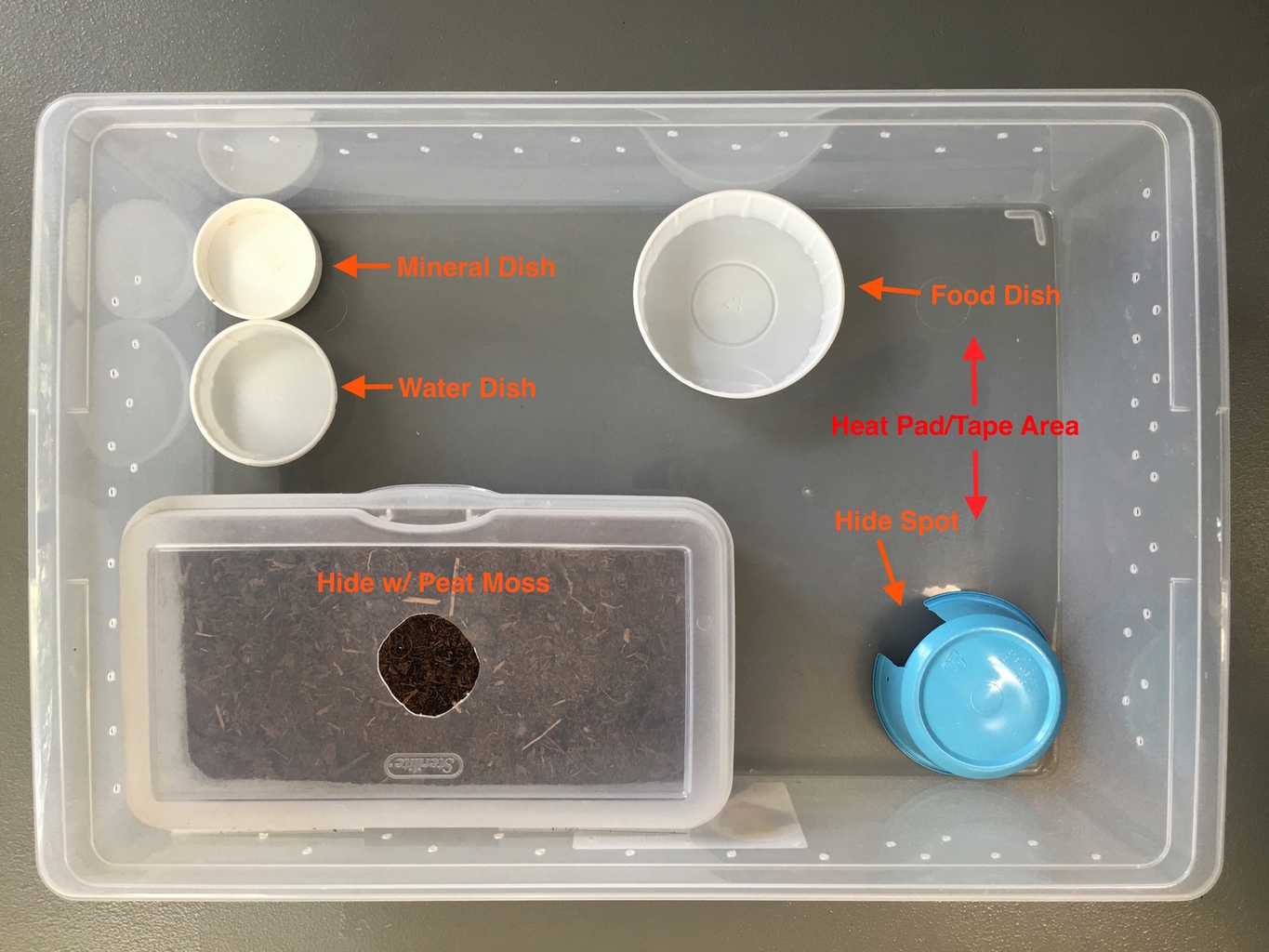
Hide spot – No Leopard gecko habitat is complete without a proper hide spot. It’s really important, and central to your gecko’s existence. It should be large enough to allow the gecko(s) to comfortably climb into and move around, but small enough to provide a “secure” feeling.
We use plastic shoe boxes filled halfway with slightly dampened peat or sphagnum moss with great success, as do many breeders, but you could also use something of similar size that’s a bit more attractive for a display cage, such as curved cork bark or faux-caves.
Ideally, provide two hide spots–one on the warmer end of the cage, and one on the cooler end. Your geckos will thank you!
Here’s a great hide spot that we highly recommend:
Water dish – This should be shallow and doesn’t need to be large, just 2-3 inches in diameter is perfect. But, keep the water fresh by replacing it every couple days. We recommend sterilizing the water dish once per week with a mild 5% bleach solution, or other similar product such as Virosan or Nolvasan.
Food dish – We also recommend having a shallow food dish available in the habitat. This is where you can place mealworms, superworms, or waxworms for the Leopard geckos to consume at their leisure. Make sure the worms can’t escape–this can be accomplished with virtually any smooth-sided dish. Leopard geckos often prefer to eat at night (they are nocturnal after all), so leave the food dish in the enclosure overnight.
Vitamin/calcium dish – While this is optional, we do maintain a small dish of vitamins and/or calcium in the habitat at all times. Leopard geckos will naturally lick the supplement when their bodies need more minerals.
This is especially important for babies and juveniles as their bodies are growing rapidly. It’s less important for adults, unless the females are breeding, in which case they’ll need plenty of calcium.
Here’s an example of a very successful Leopard gecko habitat, this one is from a rack. There is no substrate shown. Note the importance of having one hide placed upon the heated side of the enclosure. The other hide is on the cooler end of the cage, and contains dampened peat moss for digging and egg laying. With Leopard geckos, you can get as simple, or as fancy, as you’d like–as long as these basic needs are met. Click the photograph for a larger version.
Step 4: Decorations such as plants (live or artificial) are a nice touch, as are climbing rocks and branches, but make sure they’re secure and won’t topple onto your gecko. Leopard geckos love to explore and investigate, so offer them a fun habitat that allows them to do so.
The best live plants for Leopard geckos are Pothos in our opinion. They are a tough, long-lived plant that is non-toxic and grows well without much light. Here’s a link for purchasing a live Pothos plant.
Step 5: One of the most common questions when creating a Leopard gecko habitat is, “How do I light the enclosure?” Fortunately, they don’t require UVB lighting and, in fact, they don’t require any lighting whatsoever. They are nocturnal, remember?
However, for viewing the enclosure and your geckos, you can absolutely install gentle lighting, but avoid the intensity of a spot or flood bulb. Fluorescent is a good option, or soft LEDs.
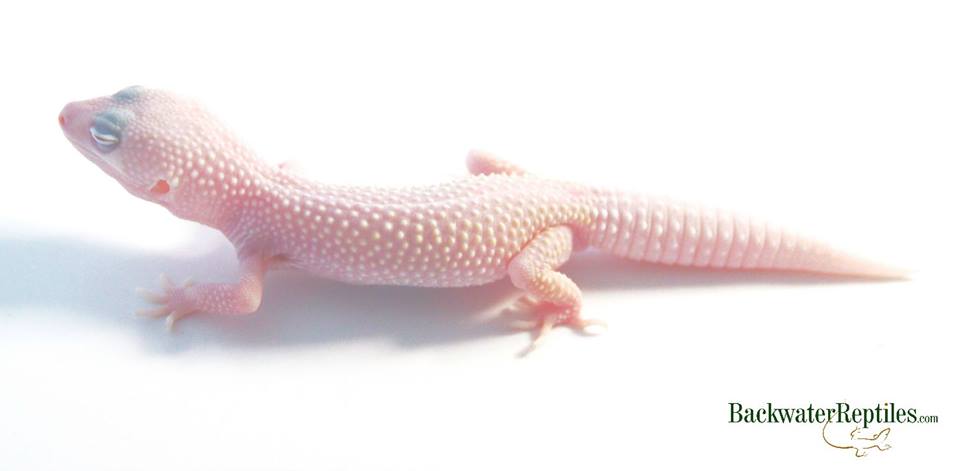
Here’s one of our Blizzard leopard gecko morphs–these albino strains often shut their eyes near bright bulbs because they are sensitive to light.
Leopard Gecko Heating
Step 6: Another very common question we receive is, “How do I heat my Leopard geckos?” Now, we’ve established that they’re nocturnal creatures, so heating them with a bright light bulb isn’t recommended like it is for diurnal (daytime) reptiles.
There are two options–you can heat your gecko with an infra-red bulb (in other words, a bulb that emits heat but not much light), or you can utilize the more common heat pad or heat tape, which gets affixed externally to the under-side of the habitat bottom, and not inside the actual cage.
Heat pads are fully assembled and ready to go right out of the box. You need one for each enclosure, and they are a great option if you’re housing just a few geckos or have just a few enclosures.
Heat tape is something you usually assemble yourself, and it’s a little more involved. It’s generally recommended if you’ll be setting up several Leopard gecko habitats because it’s much less expensive to buy and operate on a larger scale. We use three to four inch heat tape underneath our Leopard gecko habitats. We have a simple tutorial explaining how to install reptile heat tape available for you to peruse.
Super snow Leopard gecko
Whichever option you choose, make sure the heat source is on one end of the enclosure, not in the middle. This allows your gecko to “thermoregulate,” which is a fancy word for letting it choose whether it wants to be warm or cool. There should always be a warm side, and a cool side, of the habitat.
Also, don’t let the heat pad/tape rest on anything flammable (wood, for example), and try to keep a 1/8″ – 1/4″ gap between the heat pad/tape and the structure the cage is resting upon.
Your target temperature for the inside surface of the Leopard gecko habitat directly above the heat pad/tape is right around 87F-92F. In other words, the surface on which the Leopard geckos will come into direct contact. This is ideal and has proven to be the best temperature range by countless breeders. Don’t shut the heat off at night. We leave our’s on 24 hours per day. You can use a digital infrared sensor to check the temperature–you just point at the surface and click the button for a digital readout. Here’s a link to an excellent model:
Lastly, be sure to use a thermostat or rheostat with your heat pad/tape. If you plug the heat pad/tape directly into the wall, it will heat in an unregulated manner and can get far too hot, even dangerously so.
This is why we use an electronic thermostat, which maintains whatever temperature we input. They are about $50-$100, but if you’re looking for a more cost-effective solution, a reptile rheostat is a great option as well. Rheostats are around $15-$20 (Amazon link below) and work just like a light dimmer in a house, so you just turn the dial for lower or higher temperatures. Our most recommended heat pads are linked below as well.
Step 7: Ventilation is the final item to check off the list. Make sure there is plenty of circulation to avoid stagnant air. This will not only increase the oxygen exchange, but will also prevent the habitat from becoming too wet, humid, and smelly.
Creating a Leopard Gecko Habitat – Conclusion
Hopefully you’re now prepared to design your own Leopard gecko habitat using the above instructions. As usual, if you have any questions at all, just leave us a comment below. If you haven’t yet purchased your own gecko, you can do so now on our page of Leopard geckos for sale–we’ve got many different captive bred sizes and morphs available, and we can ship right to your doorstep!
We also have a tremendous offering of feeder insects available.
Here’s an excellent, easy-to-read book on keeping Leopard geckos in captivity, and we highly recommend you get yourself a copy. You just can’t go wrong with anything written by Philippe De Vosjoli: