Mealworms as Feeder Insects

If you have an insectivorous pet reptile or amphibian of any variety, odds are you have at least heard of mealworms. But just in case you haven’t, you should know that in the reptile enthusiast world, mealworms are feeder insects that are commonly consumed by virtually every type of critter that needs protein in its diet.

In this article, we’ll touch upon the life cycle of the mealworm, tell you why you should feed your critter mealworms, and even discuss how you can raise feeder mealworms of your own.

What are feeder mealworms?

Mealworms are the larval form of a beetle called the mealworm beetle (Tenebrio molitor). They essentially look as their common name describes them – like worms. If you examine them closely, however, you will be able to see that they do have segmented bodies with short legs towards their heads.

When in the larval state, mealworms are light brown and can have darker brown accent bands. Standard size worms will range in size from a quarter of an inch up to three quarters of an inch. There are also giant mealworms available, which measure approximately an inch long on average.

In their natural habitat, mealworms can be found in dark, damp and warm places such as underneath decaying logs or compost. They are composters by nature  and will essentially eat anything that is decomposing, including garbage.
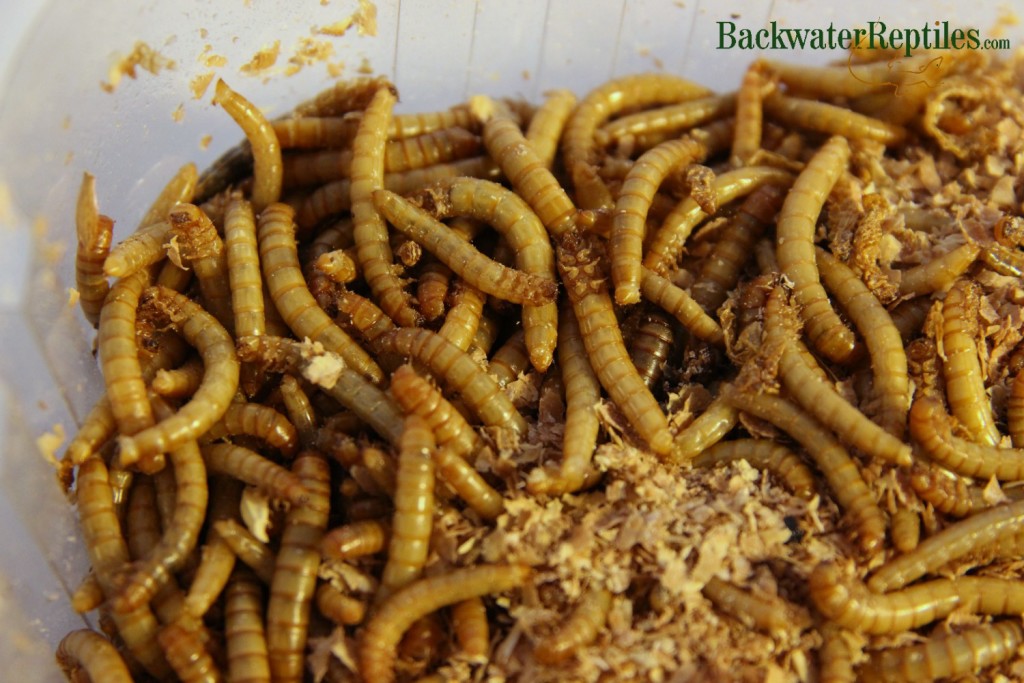
mealworms as feeder insects
These mealworms are being kept in a container that is too tall for them to climb out of.

Why should I use mealworms as feeder insects?

Mealworms are readily available at pet stores and are extremely common feeder insects for all types of exotic pets. This is mainly because they are extremely high in protein content which makes them very nutritious to reptiles and amphibians.

Reptiles and amphibians such as bearded dragons, frogs, chameleons, leopard geckos, and even some turtles enjoy eating mealworms. In fact, pretty much any carnivorous reptile, amphibian, and even tarantulas and scorpions on occasion will consume mealworms.

Because mealworms can vary so much in size, we do recommend that you carefully assess whether or not the mealworm in question is too large for your pet. Generally, if the invertebrate is not larger than the space between the eyes of the animal that will be consuming it, it is safe to feed to your pet.

Interestingly enough, mealworms can also be frozen or dried as a means to preserve them. However, we want to make it clear that not many reptiles or amphibians will recognize dead insects as a food source. The movement of the invertebrate is usually what triggers the food response in your pet, so a dead mealworm is not usually a viable option for most owners, even if it might be more convenient. We’ve really only seen dried/frozen mealworms work as feeders for aquatic eaters like some species of turtle.

How can I raise mealworms of my own to feed to my pet?

mealworm
On this close up photo of a single mealworm, you can see that this “worm” has small legs near its head.

Once they have stored up enough energy to transform into the next phase of their life cycle, a mealworm will become a pupa and then a beetle afterwards. If you want to continue the life cycle of your mealworms on your own, it won’t really require much effort on your part.

If you intend to prolong the shelf life of the larval worm stage, keep uneaten worms in the refrigerator and take them out every few days to feed them. The cold will slow their metabolisms and hopefully give you more time with the worm phase (i.e. the edible phase).

Once you are ready to start the worms breeding, all you need is a container, substrate, food, water, and approximately a hundred worms to start your colony.

A container tall enough that the worms can’t crawl out is all you need. Your mealworm’s substrate will be its food. Wheat bran, oatmeal, corn meal, and other dry grainy foods are all options.

Don’t put a water dish in the enclosure as the worms will just drown. Instead, some water-heavy veggies are the way to go. Try putting some potato slices, carrots, or apples in the mealworms’ home for the best results.

Allow the life cycle to continue on and remove any new beetles and pupa as they accumulate.

Conclusion

Mealworms are very tasty treats for reptiles and amphibians of all types. If you own a carnivorous pet, odds are it will avidly consume mealworms.

Backwater Reptiles sells feeder mealworms of various sizes and in various quantities.

Biggest Pet Toads

We love toads of all shapes and sizes at Backwater Reptiles, but sometimes we just can’t help but be impressed by the size of some of the species we sell. If you love toads and you want an impressive specimen to add to your collection, read on to find out the biggest pet toads sold at Backwater Reptiles.

South American Marine Toad (Rhinella marina)

This is definitely the biggest toad on our list. This species is very closely related to and often even classified as the same species as the common cane toad (Bufo marinus), which is described later on in this article.

However, we are discussing the South American marine toad as a separate species because the animals that are directly from South America are much larger than the cane toads that have been introduced to other areas of the world as a means of pest control.

biggest pet toads
As you can see, the South American giant marine toad get really big! This toad is being held by a 200lb adult man.

South American marine toads can attain snout to vent lengths of close to ten inches and that measurement doesn’t include their powerful limbs! There are some pictures circulating online of specimens much larger!

These toads are classic-looking in appearance, meaning they have bumpy, ridged, skin and are a flat brown in color.

People enjoy keeping these South American giants because their size is simply so massive. Big size equals big appetite and these toads do not disappoint when it comes to feeding time. They are quite entertaining to feed and they will consume large feeder insects with no qualms.

If you are interested in one of these giant beauties, Backwater Reptiles has South American giant marine toads for sale.

Smooth Sided Toad (Bufo guttatus or Sapo dorado)

We bet you can’t guess where this toad gets its common name? If you said from its relatively smooth skin (at least for a toad anyways), you’d be correct. While most species of toads are recognized for their warty skin texture, the smooth sided toad has only a few flat, dark bumps. It also has some striking eyes with a red-brown belly covered in cream-colored spots or speckles.

smooth sided toad
The reddish brown underside of the smooth sided toad is visible in this photo.

This is a tropical toad species and will therefore require more humidity and heat than is necessary for a standard American toad. Their preferred habitat is leaf litter, so be sure to give them a substrate that is similar in nature such as peat moss or coconut husks so that they can burrow and hide.

Female smooth sided toads can grow to be around ten inches long, whereas the males will stay slightly smaller. Males tend to only grow to be five to six inches long on average.

Backwater Reptiles has smooth sided toads for sale.

Cane Toad aka Marine toad (Bufo marinus)

As we’ve already mentioned, cane toads are very closely related to the South American giant marine toad and are actually very commonly even considered to be the same species.

For the sake of this blog article, we’re grouping the South American toad and the far more common cane toad (which to confuse things further is also simply called the “Marine Toad”) separately as they can originate from different locations and have a sizable difference in total proportions.

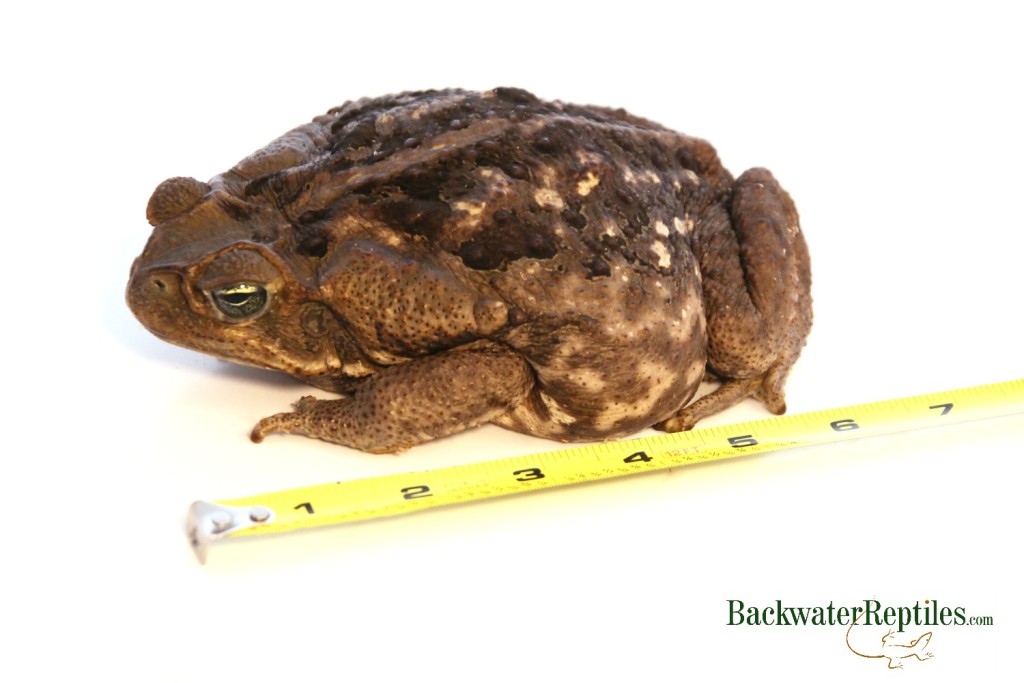
large cane toad
The measuring tape in this photo shows that this is a sizable cane toad.

Cane toads are found commonly in the United States, Central America, and South America. They have been introduced into other places as forms of pest control and are actually considered invasive species by a lot of communities.

Well-fed, captive cane toads can grow quite large because they do have monstrous appetites. A large size for a cane toad is around eight inches long, although some will get larger.

Cane toads can also get fat if you don’t watch what you feed them. Like all the toads on this list, they will eat pretty much any invertebrate they can fit in their mouth. We feed ours crickets, roaches, meal worms, night crawlers, and occasional wax worm treats.

If you want a cane toad of your own, Backwater Reptiles sells them. We’ve also written an article detailing the history of the invasive nature of this species and how you can be a responsible cane toad owner.

Conclusion – Biggest pet toads

Most toads are pets that are better for being exhibited than being handled. In other words, even large toads with less finicky temperaments than their smaller cousins still don’t really enjoy being handled. We recommend them as pets for people who are fine with a less than interactive animal.

If you’re in the market for a very large toad that you can show off to your friends and family, the toads on this list are all good species to start with.

What to Do If Your Pet Scorpion is Gravid

Even if you haven’t taken steps to breed your pet scorpion, it’s possible to receive a new pet scorpion and – lo and behold – it’s a girl and she’s gravid. By the way, when a scorpion female is going to have babies, we don’t call her “pregnant.” The appropriate term is gravid.

If you plan to keep mating pairs of scorpions in the same enclosure or you happened to discover your female scorpion is gravid, then read on to have these frequently asked questions addressed:

-How can I tell which gender my scorpion is?
-How do I know if my pet scorpion is gravid?
-How do I care for my gravid scorpion?
-What happens when my scorpion gives birth?

How can I tell which gender my scorpion is?

First of all, if you have a juvenile or very young scorpion, odds are it will be nearly impossible to distinguish the gender of the animal. Until they are fully mature, scorpions species of both genders tend to look nearly identical.

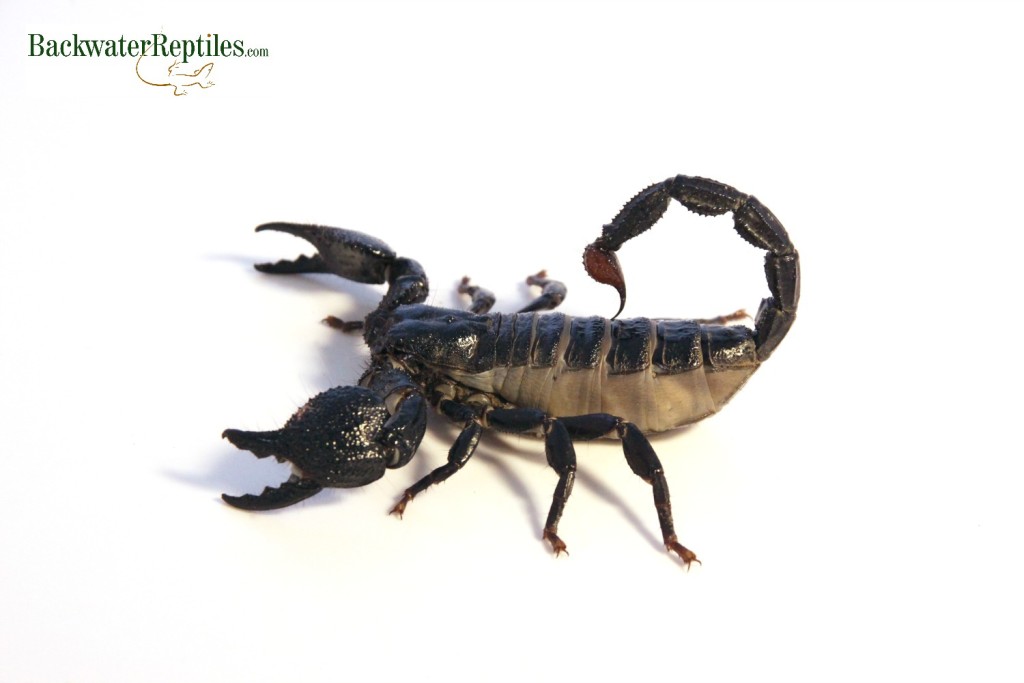
gravid pet scorpion
Pictured is a gravid Pandinus dictator scorpion.

If you are dealing with a fully mature scorpion, there are several tricks used to determine the animal’s gender. You can assess the animal based on its physical traits. Females are generally larger than males with thicker, heftier bodies. Males tend to appear longer and skinnier with longer, thicker, or fuller pincers (AKA pedipalps).

You can also take a look at the underside of your scorpion at what are called pectines. These are a series of comb-like sensory organs that are visible on the last pair of legs closest to the tail. Males will have very long, defined pectines, whereas the female’s will be shorter. Place the scorpion on a see-through surface to look at the pectines. It’s not wise to try to flip the scorpion on its back as this could stress the animal and incite it to sting.

How do I know if my pet scorpion is gravid?

You can assume your female scorpion is gravid by witnessing actual mating behavior between two animals.

If you happen to see two scorpions whose pincers are locked together doing a sort of dance, you have just witnessed scorpions breeding. When scorpions mate, the male deposits a sperm packet on the ground and then drags the female over it. Hooks on the sperm packet latch onto the female’s genital opening and fertilization occurs internally.

If you haven’t actually seen your scorpions mating, you will probably notice a change in your scorpion’s physique. Like any pregnant animal, gravid scorpions will swell up due to carrying the babies internally.

A gravid female’s abdomen will enlarge, stretch, and even become semi-transparent. It’s not uncommon to be able to see the outlines of baby scorpions through her skin!

gravid pandinus dictator
This side view of a gravid Pandinus dictator scorpion shows how the female’s abdomen is stretched and swollen. The babies are even visible!

How do I care for my gravid scorpion?

Not a lot should change when caring for a gravid scorpion. Obviously, your scorpion will be very hungry, so don’t neglect to feed her regularly.

She might also be shier or more aggressive, so we recommend providing plenty of places for her to hide out if she doesn’t feel social. Keep the handling of her to a minimum as you don’t want to stress her out or risk being stung due to an unpredictable temperament.

Gestation can range from seven months to a year, so watch her closely as care requirements will need to adjust slightly once the scorplings are born.

What happens when my scorpion gives birth?

Most females will bear anywhere from eight to thirty babies. The scorplings are born alive as scorpions do not lay eggs.

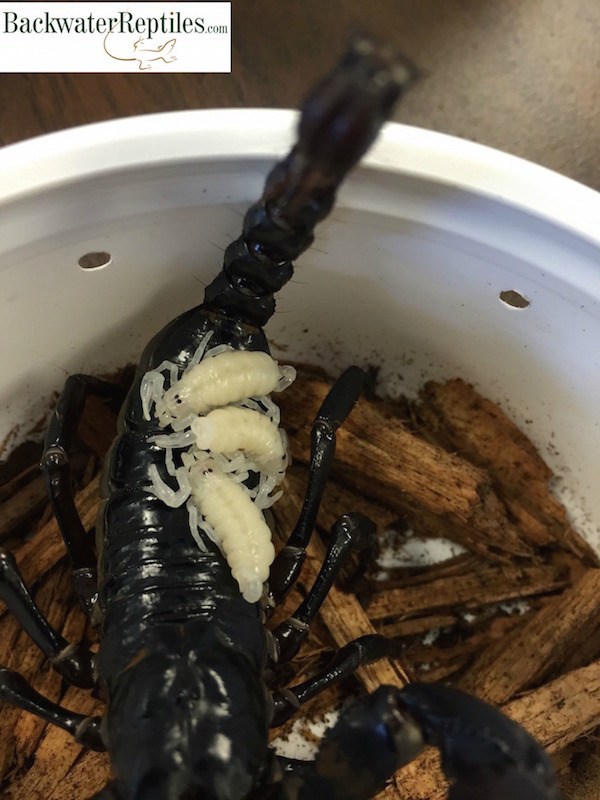
The babies will be white or nearly transparent and will stay attached to the mother’s back until their first molt.

If you keep multiple scorpions in the same enclosure, be sure to remove all other scorpions once the babies are born. Don’t move the mother as this will stress her out unnecessarily. She will get aggressive, defensive, and stressed if other scorpions are present. Not to mention you don’t want any cannibalism to occur.

scorplings
Baby scorpions (AKA scorplings) ride on their mother’s back until their first molt.

Never attempt to dislodge the scorplings from the female’s back. There is a high chance she will eat them if you attempt this. Plus scorplings that are raised by the mother fare much better and are healthier overall.

The baby scorpions will eat small insects. Pinhead crickets, small waxworms, and freshly molted small mealworms are all acceptable food for scorplings.

Conclusion – Gravid pet scorpions

Scorpion breeding will occur naturally if you house a mating pair together. Keep an eye out for swollen, stretched abdomens as this is the best way to tell if your scorpion is expecting.

Think you want to start a scorpion family of your own? Backwater Reptiles has quite a selection of scorpions for sale. You may end up with a gravid pet scorpion of your own!